
|
Our Closed-Loop Systems will maintain peak
performance from your water-cooled machinery and cut
installation and operating costs. |
|
| COST
AND OPERATIONAL ADVANTAGES
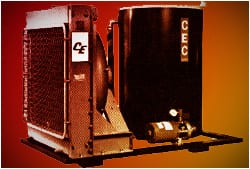
CEC's industrial coolers are specifically
designed to dissipate the heat generated in a variety of
industrial machinery. Compare our closed-loop solution
to your current method for cooling your machinery:
- CEC coolers recirculate one tank of water, eliminating the need
for a continuous and expensive on-line water supply.
- CEC coolers also eliminate the complications and expense of
industrial effluent. Your water will no longer pass
through once and be a disposal problem.
- CEC coolers cut installation costs. Because they are
self-contained, they can be positioned next to the equipment
they are cooling. There is no need to install long
runs of pipe from a remote water source.
- CEC coolers perform well in cold weather. If your location
experiences periodic cold temperatures, anti-freeze will
prevent any freeze-ups.
- CEC coolers eliminate the mineral deposit buildup in your
equipment that often is associated with an on-line fresh
water source.
- CEC coolers eliminate condensation on your equipment because
water temperatures are higher than ambient.
- CEC coolers will give a long service life. They are
constructed from heavy duty, corrosion resistant material
for long, trouble-free operation in the toughest industrial
conditions.
- CEC coolers modular design is easy to maintain.
- CEC coolers arrive fully assembled on a welded steel base that
permits handling with a lift truck.
- CEC coolers come in stock capacities to handle a wide range of
cooling requirements. Special designs can be
accommodated.
|
AVAILABLE FROM STOCK Factory Proven, Easily Installed for Any
Application.
CEC Closed-Loop Coolers plumb directly to
your equipment's inlet and outlet water ports with no
additional plumbing required. |
|
|
DETERMINING THE RIGHT COOLER FOR YOUR APPLICATION
CEC water coolers come in five standard sizes with
dissipation capacities of 20, 50, 100, 150, 200 and 250
hp. The procedure for selecting the right cooler for
your application is:
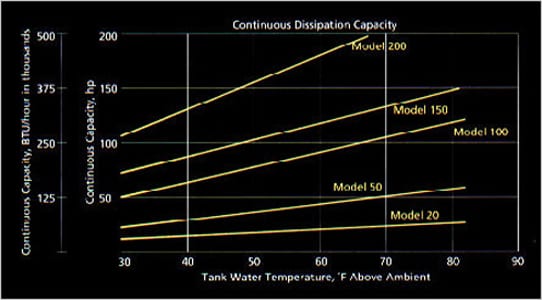
- First, calculate the average
heat load requirements of all components for which the water
cooler will provide cooling water (see the graph and
formulas below.)
- Next, estimate the maximum
temperature of the area where the cooler will be located
(ambient temperature.)
- Then, from the graph below,
select the cooler which can dissipate the heat load without
the water tank temperature exceeding
150oF.
|
|
CALCULATING HEAT LOAD
Water heat load, btu/hr =
(ToFout - ToFin) x
gpm x 500 Oil heat load, btu/hr =
(ToFout - ToFin) x
gpm x 210 Brake heat, hp =(web tension,lbs x web
speed, fpm) ÷ 33,000 Clutch or brake hp = (torque,
in-lb x slip rpm) ÷ 63,00 Energy equivalents: 1 hp =
42.5 btu/min = 2550 btu/hr 1 kw = 3413
btu/hr |
CEC STANDARD COOLER SPECIFICATIONS
|
| Water Cooler size |
. |
Model
20 |
Model
50 |
Model
100 |
Model
150 |
Model
200 |
| |
|
|
|
|
|
|
| Physical Dimensions
|
Length, inches |
50 |
48 |
62 |
62 |
62 |
|
Width, inches |
27 |
42 |
38 |
38 |
45 |
|
Height, inches |
29 |
42 |
48 |
48 |
55\ |
|
Tank Capacity,
gallons |
30 |
55 |
100\ |
100 |
150 |
|
Ship weight, lbs |
200 |
400 |
700 |
800 |
1100 |
|
Operational weight,
lbs |
500 |
900 |
1500 |
1800 |
2400 |
| |
|
|
|
|
|
|
| Radiator
Characteristics |
Motor hp, 3-phase,
TEFC |
1/4 |
1/2 |
2 |
2 |
3 |
|
Air flow, cfm |
2240 |
5450 |
5000 |
7400 |
10,300 |
|
Sound level, db |
72 @ 7
ft |
78 @ 7
ft |
76 @ 25
ft |
78 @ 25
ft |
83 @ 25
ft |
| |
|
|
|
|
|
|
| Pump Characteristics
|
Motor hp, 3-phase,
TEFC |
1 |
1 |
1-1/2 |
1-1/2 |
1-1/2 |
|
Flow, gpm, @ 60 head in
feet* |
50 |
50 |
65 |
65 |
65 |
|
@ 70 head in feet |
35 |
35 |
58 |
58 |
58 |
|
@ 80 head in feet |
10 |
10 |
50 |
50 |
50 |
|
@ 90 head in feet |
- |
- |
32 |
32 |
32 |
|
|
|
|
|
|
|
Recommended Pipe Size,
inches |
Up to 30 feet total
length |
1/2 |
1/2 |
3/4 |
3/4 |
3/4 |
|
30 to 80 feet total
length |
3/4 |
3/4 |
1 |
1 |
1 |
| * Head in feet ÷ 2.31 = psi
(water) |
|
|
|
| |
OPTIONAL FEATURES
- High water temperature
cut-off switch.
- Low water flow cut-off
switch
- Sight flow indicator
- Low level switch
| | |